

Stores that price match allow consumers to buy products at the lowest prices. But only if you shop at the “right stores” and understand how their policies work.
This page is your starting point. Instead of reading dozens of policies, you’ll find:
For detailed rules and edge cases, you can jump to individual store pages or read our full guide on how price matching works.
Below are some of the most popular retailers that offer price matching. Each store has different rules, so click through to see exact details.
Best Buy – One of the most well-known price match programs for electronics.
Learn more about the Best Buy price match policy.
Walmart – Matches select online competitors with strict exclusions.
See the full Walmart price match policy.
Target – Offers price matching for select online and local competitors.
Read the Target price match rules.
Home Depot – Matches select online and in-store competitors for identical products.
Review Home Depot price-matching details.
Lowe’s – Requires exact SKU matching but allows manager discretion in some cases.
Understand Lowe’s price match rules.
Related: Does Ace Hardware price match?
Staples – Matches select online and local competitors.
Costco – Focuses more on price adjustments than competitor price matching.
Kohl’s and Macy’s – Offer price matching with notable exclusions.
However, there are a few things that differ between stores that price match.
Related: Does JCPenney price match?
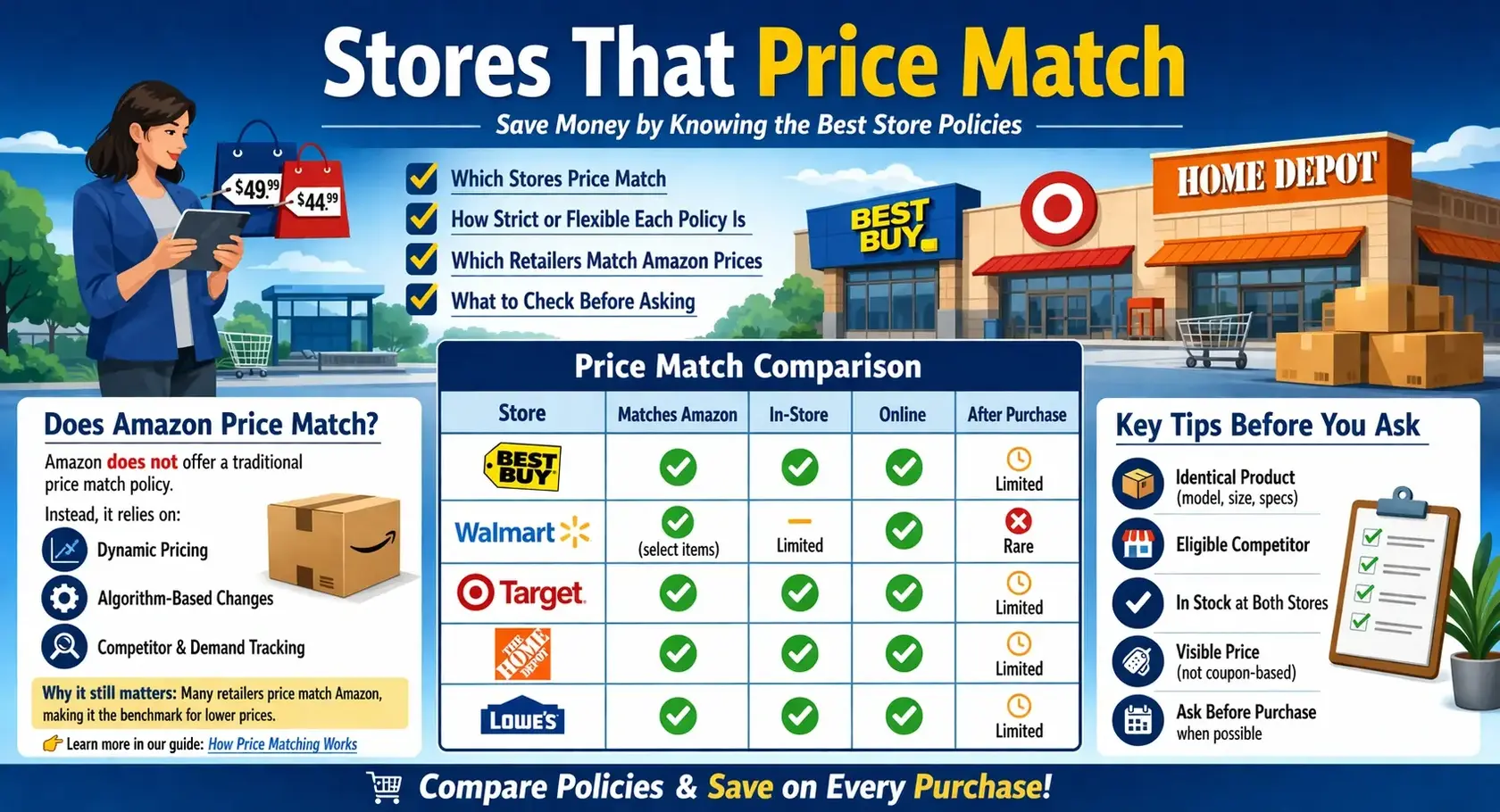
Amazon does not offer a traditional price-match policy, but many retailers price-match Amazon.
Stores like Best Buy, Target, and Walmart know that shoppers compare prices against Amazon first. So in a way, Amazon often acts as the benchmark price.
Amazon does not match prices on request; instead, it relies on:
For a full explanation, see our guide on how price matching works.
Here’s a high-level comparison to help you decide where price matching is easiest.
| Store | Matches Amazon | In-Store | Online | After Purchase |
|---|---|---|---|---|
| Best Buy | Yes | Yes | Yes | Limited |
| Walmart | Yes (select items) | Limited | Yes | Rare |
| Target | Yes | Yes | Yes | Limited |
| Home Depot | Yes | Yes | Yes | Limited |
| Lowe’s | Yes | Yes | Yes | Limited |
Best Buy and Target are generally the most flexible among major retailers. If you are searching for similar products, Home Depot and Lowe’s work best for identical SKUs.
Related: How To Find Wayfair Items On Other Sites
The largest retailer in the US, Walmart, is strict when it comes to price matching. However, the store offers Walmart online vs in-store price match to customers.
PennyCanny research team found that post-purchase price matching is uncommon across all stores. So, always check the store-specific policy beforehand if you are buying something expensive.
Most failed price match attempts come down to missed details, not bad luck.
Before you ask for price matching, confirm the below details:
A little attention to detail increases the chances of price-match approval, especially at stores like Best Buy and Home Depot. This means customer care associates can verify details in real time and help you out quickly.
Shopping at stores that price match helps you save money. The biggest benefit is paying the lowest price while still enjoying the convenience of local retailers. Major chains like Best Buy, Target, Home Depot, Lowe’s, and Kohl’s continue to offer price matching. This makes in-store shopping more competitive with online marketplaces.


Beauty
100+ Companies That Offer Student Discounts Online

Extreme Couponing
Find The Best Grocery Stores For Couponing In USA

Extreme Couponing
Top Stores That Offer Military Discounts To Veterans

Extreme Couponing
Top Websites Like Groupon That You Should Explore in 2026

Extreme Couponing
Best Coupon Websites for Online Shopping in 2026

Extreme Couponing
Temu vs Shein: 9 Key Comparisons of eCommerce Beasts

Extreme Couponing
Walmart Online vs In-Store Prices: How are they different?
Explore More →