
Price matching lets you buy an eligible product at a competitor’s lower price. You show the retailer the lower offer, and it checks the price against its policy. If the offer qualifies, the retailer matches it. Some stores also offer online price matching or allow requests after purchase. Rules vary by retailer. Here is what price matching means, how it works, and what to check before you ask.
Price matching means asking a retailer to match a lower price offered by an eligible competitor for the same product.
For example, a blender costs $120 at Store A. An eligible competitor sells the identical blender for $100. If Store A’s policy covers that competitor and offer, it may sell you the blender for $100.
The usual process is:
The details matter. A retailer may limit eligible competitors, require the item to be in stock, or exclude coupons, clearance prices, marketplace sellers, and special promotions.
Looking for a specific retailer? See our stores that price match guide for retailer-specific policies.
Price matching is a retailer policy that allows shoppers to request a lower price when an eligible competitor sells the same product for less.
The goal is simple. You find a lower price elsewhere. The retailer gives you the qualifying lower price instead of losing the sale.
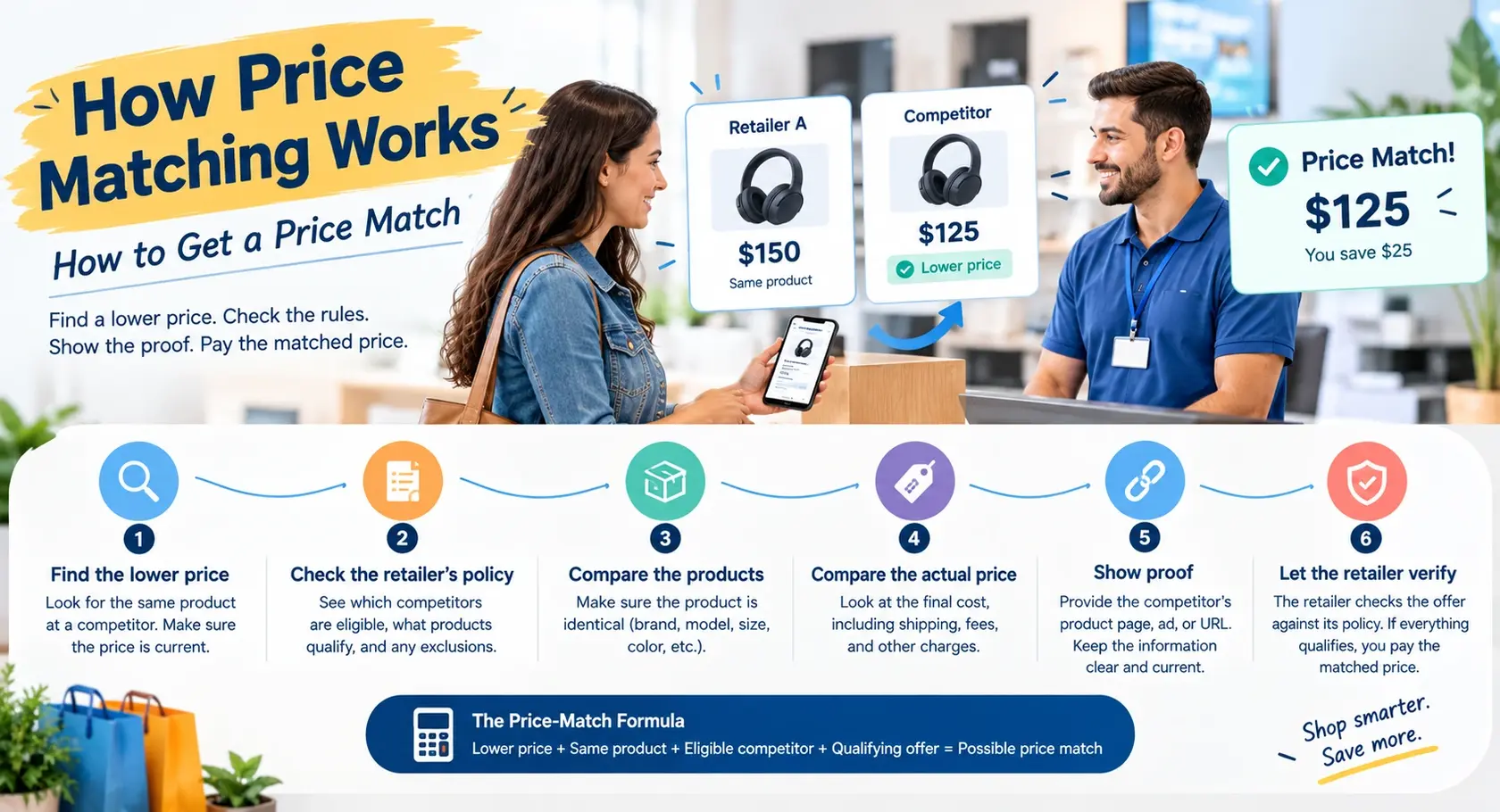
You want headphones.
You show Store A the competitor’s current $125 offer. If it meets the store’s policy, you pay $125.
That is a price match.
A price match means a retailer agrees to meet a qualifying competitor’s lower price.
The rules are not universal. Each retailer sets its own terms.
A policy may specify:
This means a lower price alone does not guarantee a match. The offer must also meet the retailer’s conditions.
Most price matches follow the same basic path.
Look for the same product at another retailer.
You may find the offer on a website, product page, advertisement, or in a store.
Check that the price is current. An expired sale or unavailable product may not qualify.
Before making your request, look at the retailer’s current price-match rules.
Start with the competitor list. Some stores match selected retailers only. Others have broader requirements.
Then check the rules for online purchases, stock, promotions, and exclusions.
The products usually need to be identical.
Check details such as:
A similar product is not necessarily the same product.
For example, two 55-inch TVs may look alike but have different model numbers and features. A retailer may reject the match.
Look beyond the headline price.
An online competitor might list an item for $80 but charge $15 for shipping. A retailer may compare the final qualifying cost instead.
Other factors can include:
The retailer’s policy determines what counts.
You may need to provide the competitor’s product page, advertisement, or other proof.
For an online price match, the retailer may ask for the product URL.
For an in-store request, you might show the competitor’s current advertisement or website on your phone.
The retailer may verify the offer itself, so keep the information clear and current.
The retailer compares the offer with its policy.
It may check the product, competitor, current price, availability, seller, and offer terms.
If everything meets the requirements, the retailer applies the qualifying price.
If something falls outside the policy, the request may be denied.
Think of price matching this way:
Lower price + same product + eligible competitor + qualifying offer = possible price match
The word “possible” matters.
Price matching is a policy, not an automatic right to the lowest price you find.
The same principle applies when you shop online. The retailer may offer an online price match, but its website may have a separate process or additional conditions.
And if you have already bought the item, the retailer may have a separate price adjustment policy. That is not always the same as a price match.
Yes, some retailers let you price match online. The process varies by store.
You usually start by finding the same product at a lower price on another retailer’s website. If that retailer and offer qualify, you submit the lower price for review.
The request may happen through an online form, live chat, customer service, or during checkout. Some retailers require you to request the match before ordering. Others allow requests after purchase.
Suppose a retailer sells a coffee maker for $140. An eligible competitor lists the identical model for $115.
You submit the competitor’s product page through the retailer’s price-match process. The retailer checks the offer against its policy. If it qualifies, the $115 price is applied to your order.
The important part is not where you found the lower price. It is whether the offer meets the retailer’s rules.
Some stores limit online matches to specific competitors. Others may exclude marketplace sellers, membership prices, coupons, clearance offers, or special promotions.
Shipping can matter too.
A competitor may list the product for $75 but charge $12 for delivery. The retailer may compare the total qualifying cost rather than the advertised product price.
So when you price match online, check the full offer.
Sometimes. It depends on the retailer’s policy.
A store may match prices from selected online retailers but exclude auction sites or third-party marketplace sellers.
The seller matters. A product shown on a marketplace may be sold by an independent merchant rather than the marketplace itself. That can affect eligibility.
Before you submit a request, check both the competitor and the seller.
The process is simple.
Find the lower price. Check the policy. Compare the offer. Submit your request.
Start by finding the same product at a lower price. Then check whether the competitor qualifies under the retailer’s policy.
Compare the product details. The model, SKU, size, quantity, condition, and included items may need to match.
Next, check the offer itself. Make sure the price is current. Look for shipping charges, required memberships, coupons, or other conditions that could change the comparison.
Then gather your proof.
For an online price match, the competitor’s product URL is often the most useful evidence. The retailer may also accept a screenshot or advertisement. An in-store request may simply require you to show the competitor’s current price on your phone.
Submit the request through the retailer’s approved channel. If the offer meets the policy, the retailer applies the matched price.
If the retailer does not offer a price match, you still have another way to lower the cost. PennyCanny helps shoppers find current coupons and promo codes from thousands of stores before they buy. You can check the available offers for a retailer and compare your potential savings before completing your purchase.
Do not start with the request. Start with the policy.
A quick policy check can tell you whether the competitor qualifies, whether online prices count, and which offers are excluded.
It also helps to keep the competitor page open until the request is finished. Online prices can change quickly.
If the lower price comes from a coupon, clearance sale, marketplace seller, or unusual promotion, check the exclusions before you make the request.
The basic idea is easy. The tricky cases are where the rules matter.
A laptop costs $900 at Store A.
An eligible competitor sells the identical model for $825.
The offer meets Store A’s policy, so the retailer matches the $825 price.
You save $75.
A vacuum costs $240 on a retailer’s website.
An eligible competitor lists the same model for $210.
You submit the competitor’s product URL. The retailer verifies the offer and approves the request.
Matched price: $210.
This is a standard online price match.
A camera costs $500 at Store A.
A competitor lists it for $470, but charges $40 for shipping.
The competitor’s total cost is $510.
Whether Store A matches the $470 price depends on its policy. Some retailers consider shipping. Others use a different price comparison.
The lesson is simple: check the total offer, not just the headline price.
A jacket costs $100 at your retailer.
A competitor lists it for $90 and offers a $10 coupon.
The coupon brings the price to $80.
But the retailer may exclude coupon-based prices from its price-match policy. In that case, the $80 price may not qualify.
A lower final price is not always a qualifying price.
A game console costs $450 at your retailer.
A third-party marketplace seller lists the same console for $410.
The retailer may exclude marketplace sellers. If so, the $410 offer does not qualify.
Always check who sells the product, not just where you found it.
You buy a television for $700.
Five days later, the same retailer sells it for $650.
This is usually a price adjustment, not a competitor price match.
If the retailer offers post-purchase price adjustments, you may be able to claim the $50 difference.
That is why it is useful to understand the difference between a price match and a price adjustment.
Every retailer sets its own price-match rules. There is no single rulebook that applies to every store.
The basic idea is simple. The lower price must come from a qualifying source, and the product must meet the retailer’s requirements.
That sounds straightforward. The details can make a big difference.
Retailers commonly require the products to be identical.
That can mean the same brand, model number, SKU, size, quantity, color, or version. Accessories and included items may also need to be the same.
A 55-inch television with a soundbar is not necessarily the same deal as the television alone.
The same applies to product condition. A new product may not qualify against an open-box or refurbished listing.
A retailer may only match prices from certain competitors.
Some policies cover a broad range of retailers. Others provide a specific list of eligible stores.
The competitor may also need to be an authorized seller. A lower price from an auction site, marketplace seller, or individual merchant may not qualify.
This is why where the lower price comes from matters almost as much as the price itself.
Retailers generally need to verify that the competing price is available when you request the match.
An old advertisement may not be enough. Neither is a product page showing a price that is no longer available.
The competitor may also need to have the item in stock.
A product that was briefly available at a lower price does not necessarily create a valid price-match opportunity.
The advertised price is only part of the comparison.
A retailer may consider shipping charges, required memberships, mandatory fees, or other conditions attached to the offer.
For example, a competitor might advertise a product at $100 but require a paid membership to receive that price. The retailer may exclude the offer or compare it differently.
The exact treatment depends on the store.
A retailer can set a specific period for submitting a price-match request.
Some policies require the request before you buy. Others allow it after purchase for a limited time.
The timing can also matter when a competitor changes its price.
If the lower price disappears before the retailer verifies it, the request may no longer qualify.
For that reason, it helps to check the price-match rules before making the purchase rather than assuming you can deal with the difference later.
Price-match exclusions are the part many shoppers overlook.
A competitor can have a lower price without creating a valid price match. The offer may fall into an excluded category.
The most common exclusions involve promotions, sellers, product condition, and special pricing.
A competitor may offer a $20 coupon that brings a $100 product down to $80.
That does not necessarily mean the retailer will match $80.
Many price-match policies treat coupons, promo codes, rebates, and other promotional discounts differently from an ordinary advertised price.
Check the policy before using the discounted price as your comparison.
Clearance items often have special conditions.
A retailer may exclude clearance, closeout, liquidation, or going-out-of-business prices because those prices are temporary or tied to limited inventory.
A lower clearance price can therefore be real without being eligible for a price match.
Third-party sellers are another common exclusion.
A marketplace may display several sellers for the same product. The lowest price may come from an independent merchant rather than the retailer operating the marketplace.
Some stores only match prices sold directly by the competing retailer.
Always check the seller name before assuming the listing qualifies.
A competitor may give members a lower price than ordinary shoppers.
Examples include paid memberships, loyalty programs, employee pricing, and other restricted offers.
A retailer may exclude these prices because they are not available to everyone.
Flash sales, special events, holiday promotions, and other temporary offers can have separate rules.
The same may apply to prices available only for a few hours or during a specific promotional period.
A retailer decides whether these offers qualify under its own policy.
Product condition can also determine eligibility.
A new product generally cannot be assumed to qualify against a used, refurbished, or open-box version.
The products may look identical in photographs, but they are different offers.
Retailers may exclude obvious pricing errors.
Imagine a $1,000 laptop suddenly appears for $100 because of a listing mistake. A retailer may refuse to match it.
This is another reason price matching is not simply a race to find the lowest number.
The retailer checks whether the lower offer fits its policy.
A price-match request can be denied even when you find a lower price.
The retailer still needs to confirm that the product, competitor, offer, and timing meet its policy.
Common reasons include:
A denial does not necessarily mean the lower price was invalid. It may simply mean the offer falls outside that retailer’s specific rules.
If your request is denied, check the policy for the exact restriction. If the lower offer does not qualify, you can still look for a coupon or promotional code before purchasing.
Found a lower price? Before you request the match, run through this quick check.
☐ Same product?
Confirm the model, size, quantity, condition, and included items match.
☐ Eligible competitor?
Check that the seller or retailer is covered by the price-match policy.
☐ Price available now?
Make sure the lower price is current and the product is in stock.
☐ No excluded promotion?
Check for coupons, promo codes, clearance pricing, rebates, membership prices, or limited-time offers.
☐ Extra costs included?
Look at shipping, required fees, and other conditions that could change the final price.
☐ Within the time limit?
Confirm that the request is being made within the retailer’s allowed period.
☐ Proof ready?
Keep the competitor’s product page, advertisement, or other evidence available for verification.
If all of these checks look good, the offer is more likely to fit the retailer’s stated rules. The final decision still belongs to the retailer reviewing the request.
Finding a lower price after you buy can be frustrating.
You paid $200 for a product on Monday. On Thursday, you see the same product for $175.
What happens next depends on the retailer.
Some stores allow post-purchase price matching. Others require you to request the match before completing your purchase.
There is also an important distinction between a competitor price match and a price adjustment.
A price match usually involves another retailer offering the product for less.
A price adjustment usually involves the price dropping at the same retailer after you purchase.
For example, you buy a $300 appliance. A week later, the same store reduces its price to $260.
If the store offers post-purchase price adjustments, you may be able to claim the $40 difference.
The rules can include a specific time window. A retailer might allow an adjustment for a limited number of days after purchase. The original purchase may also need to meet certain conditions.
The same idea can apply when a competitor lowers its price after you buy. If the retailer allows post-purchase price matching, you may be able to request the difference within its stated period.
Do not assume that every lower price creates a refund.
Check the retailer’s policy and look for terms such as after-purchase price match, post-purchase price adjustment, or price protection.
Keep your receipt and purchase details available. You may also need evidence showing the lower price and when it was available.
The key question is not simply, “Did the price drop?”
It is, “Does this retailer protect purchases against that type of price drop?”
That answer comes from the retailer’s policy.
Price matching and price adjustments both help you avoid paying more than necessary. But they happen in different situations.
Price matching usually means asking a retailer to match a lower price from another eligible seller.
Price adjustment usually means asking the same retailer to refund the difference after its own price drops.
For example, you find a $500 television at Store A. Another qualifying retailer sells the identical model for $450. If Store A agrees to match that price, you have received a price match.
Now imagine you buy that television from Store A for $500. A week later, Store A reduces its own price to $450. If its policy allows post-purchase adjustments, you may be able to recover the $50 difference.
| Price match | Price adjustment | |
|---|---|---|
| Lower price comes from | Another eligible retailer | The same retailer |
| Typical timing | Before or during purchase | After purchase |
| Main purpose | Match a competitor’s price | Recover a later price difference |
| Example | Competitor sells it for $450 | Your retailer later drops it to $450 |
| Policy to check | Price-match policy | Price-adjustment or price-protection policy |
The timing is another important difference.
A price match can happen before or during a purchase, depending on the retailer. A price adjustment happens after the original purchase.
Retailers also use different names for these policies. You may see terms such as price protection, post-purchase price adjustment, or price guarantee.
The names can sound similar, but the rules are not always the same.
If you see a lower price after buying something, first check whether the retailer protects purchases against later price drops. If the lower price comes from another retailer, look for its price-match rules instead.
A price guarantee is a retailer’s promise to protect you under specific pricing conditions.
It can cover price matching, post-purchase price drops, or both. The exact meaning depends on the retailer’s policy.
For shoppers, the important question is not simply whether a store advertises a price guarantee. You need to know what the guarantee actually covers.
A retailer might promise to match a competitor’s lower price before you buy. Another might let you claim a difference after purchase. Some guarantees apply only to selected products, competitors, or time periods.
Consider a simple example.
You purchase an item for $200. The retailer’s price guarantee says qualifying price differences can be claimed within 14 days. If the same retailer later sells that item for $175, you may be able to request the $25 difference.
Another retailer could use the phrase price guarantee for a completely different policy.
That is why the wording matters. Look for details about eligible competitors, products, promotions, timing, and proof.
A price guarantee is therefore not a blanket promise that you will always receive the lowest available price.
It is a set of conditions that explains when the retailer will protect your purchase.
This is where price matching can become less straightforward.
A competitor may advertise a product for $100 and offer a coupon that reduces your price to $80. You might naturally expect the retailer to match the $80 price.
That is not necessarily how price matching works.
Many retailers treat coupons, promo codes, rebates, loyalty discounts, and other promotional offers differently from ordinary advertised prices.
The distinction matters because a coupon may not be available to every shopper. It may also require a separate action before the discount applies.
For example, imagine a competitor lists a pair of shoes for $90. A promotional code reduces the price to $75.
The retailer you want to buy from may compare its price with the $90 advertised price rather than the $75 promotional price. It could also exclude the offer completely if its policy does not recognize coupon-based prices.
Membership discounts can create a similar issue.
A competitor might sell an item for $70 to members while charging everyone else $85. The retailer may consider the $85 price relevant because the $70 offer is restricted.
The same principle can apply to cashback, mail-in rebates, gift-card promotions, and limited promotional events.
Do not assume that the lowest effective price is automatically the price a retailer will match.
Instead, check how the retailer defines a qualifying price. If the offer depends on a coupon or special promotion, read the exclusions before making your request.
The basic idea is the same whether you shop online or in a physical store. You find a lower qualifying price and ask the retailer to match it.
The process can be different.
For an online price match, you will usually need to provide the competitor’s product page or another form of digital proof. The retailer may handle the request through live chat, customer service, an online form, or another digital channel.
An in-store request is often more direct. You can show the competitor’s advertisement or product page to an employee using your phone.
The retailer may then verify the product, seller, price, availability, and other requirements.
| Online price match | In-store price match | |
|---|---|---|
| Where you request it | Website, chat, form, or customer service | Physical store |
| Typical proof | Product URL or screenshot | Product page, advertisement, or phone |
| Product verification | Retailer checks the online listing | Employee verifies the offer |
| Timing | Often before checkout, depending on policy | Usually during the store purchase |
| Main concern | Current online price and eligible seller | Current competitor offer and store rules |
Neither method automatically gives you a lower price.
The retailer’s policy still controls the decision.
Online shopping can also introduce extra factors. Shipping charges, membership requirements, online-only prices, and marketplace sellers can affect whether the competitor’s offer qualifies.
In-store shopping can have different limitations. A retailer may restrict matches to local competitors or require a particular advertisement.
Before requesting a match, check the policy for the channel you are using. A store may allow price matching in person while applying different rules to online orders.
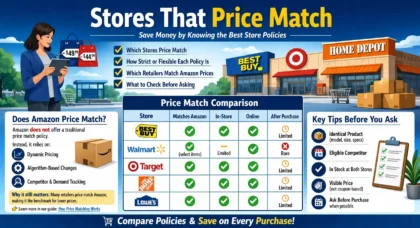
Many major retailers have offered some form of price matching or price protection, but policies vary considerably.
Some retailers match selected competitors. Others accept a broader range of qualifying sellers. Some allow requests only before purchase, while others provide a limited post-purchase adjustment period.
The list can also change over time.
That makes a simple list of store names less useful than understanding which retailers currently have a price-match policy and what their conditions are.
For example, retailer-specific rules can determine whether the store accepts online competitors, marketplace sellers, coupons, clearance prices, or post-purchase requests. JCPenney’s price-match policy is one example of why checking the individual retailer’s requirements matters.
A retailer having a price-match policy does not mean every lower price qualifies.
Always check the current policy for the specific store, product, competitor, and type of offer you want to match.
Price matching means a retailer agrees to sell you a product at a lower price offered by an eligible competitor. The product, seller, price, timing, and other conditions usually must meet the retailer’s policy. A price match does not automatically apply to every lower price you find.
The price matching meaning is simple: you ask a retailer to match a qualifying lower price from another seller. If the offer meets the retailer’s rules, the retailer may reduce your purchase price to match the competitor.
Price matching usually starts when you find the same product for less at another eligible retailer. You provide the lower price as proof, and the retailer checks whether the product and offer meet its policy. If everything qualifies, the retailer applies the matched price according to its terms.
To price match, find the identical product at a qualifying competitor and check the retailer’s policy first. Then gather proof of the current lower price and submit your request through the retailer’s approved channel. The retailer will verify the offer before approving or declining the match.
Yes, some retailers allow online price matching. You may need to submit a competitor’s product URL, screenshot, or other proof through live chat, an online form, or customer service. Online price matching can have different rules from in-store matching, so check the retailer’s policy before placing your order.
Sometimes. Some retailers allow a post-purchase price match or price adjustment within a specific period. Others require you to request the match before completing your purchase. If you find a lower price after buying, check the retailer’s policy for terms such as price adjustment, price protection, or post-purchase price matching.
Not always. Retailers may exclude prices that depend on coupons, promo codes, rebates, loyalty discounts, or other promotional offers. A competitor’s ordinary advertised price may qualify while its coupon-adjusted price does not. Check the retailer’s exclusions before using a promotional price as your comparison.
It depends on the retailer and the specific Amazon listing.
Some retailers may consider an Amazon price under certain conditions, while others exclude Amazon or marketplace sellers from their policies. The seller can also matter because an Amazon listing may come from Amazon itself or an independent third-party seller.
Always check the retailer’s current policy before treating an Amazon price as eligible.
No. A price match usually compares your retailer’s price with a lower price from another eligible seller. A price adjustment generally applies when the retailer’s own price drops after you purchase. Both can return money to you, but they are governed by different policies.
The required proof depends on the retailer. For an online price match, you may need the competitor’s product page or URL. In a store, you may be able to show an advertisement or product page on your phone. The retailer may also verify the price, seller, availability, and other details itself.
No. Price matching is a retailer-specific policy, and stores can set their own eligibility requirements. Some retailers match selected competitors, while others have narrower rules or do not offer price matching. Policies can also change, so check the current terms before making a purchase.
No. A retailer only needs to follow the conditions in its price-match policy. A lower price may be excluded because it comes from a marketplace seller, coupon, clearance event, membership program, or another restricted offer. Price matching can reduce your cost, but it is not a guarantee that every lower price will qualify.