
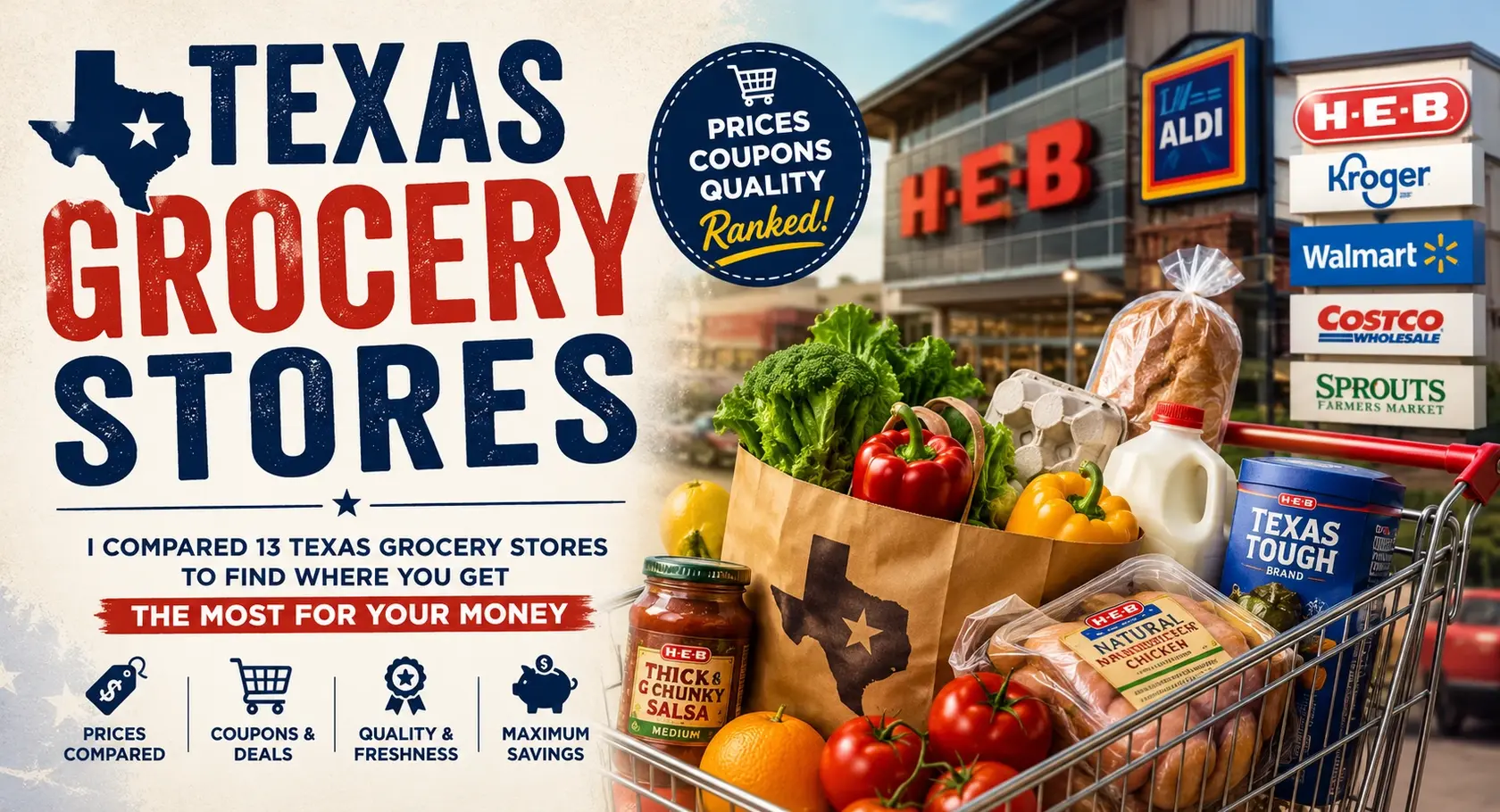
If you only read one paragraph, read this one. After comparing 13 Texas grocery stores on prices, store brands, freshness, and coupons, H-E-B offers the best overall value in Texas. Costco wins on raw price if you buy in bulk, Aldi wins for small budgets, and Kroger wins on coupons. Whole Foods costs the most.
The “cheapest” grocery store is not always the one that saves you the most. Once you factor in store brands, coupon programs, produce quality, and loyalty rewards, the rankings change considerably.
So I did what any stubborn Texan with a spreadsheet would do.
I compared the big names side by side. Prices. Store brands. Produce quality. Coupon programs. The stuff that actually decides your grocery bill at the end of the month.
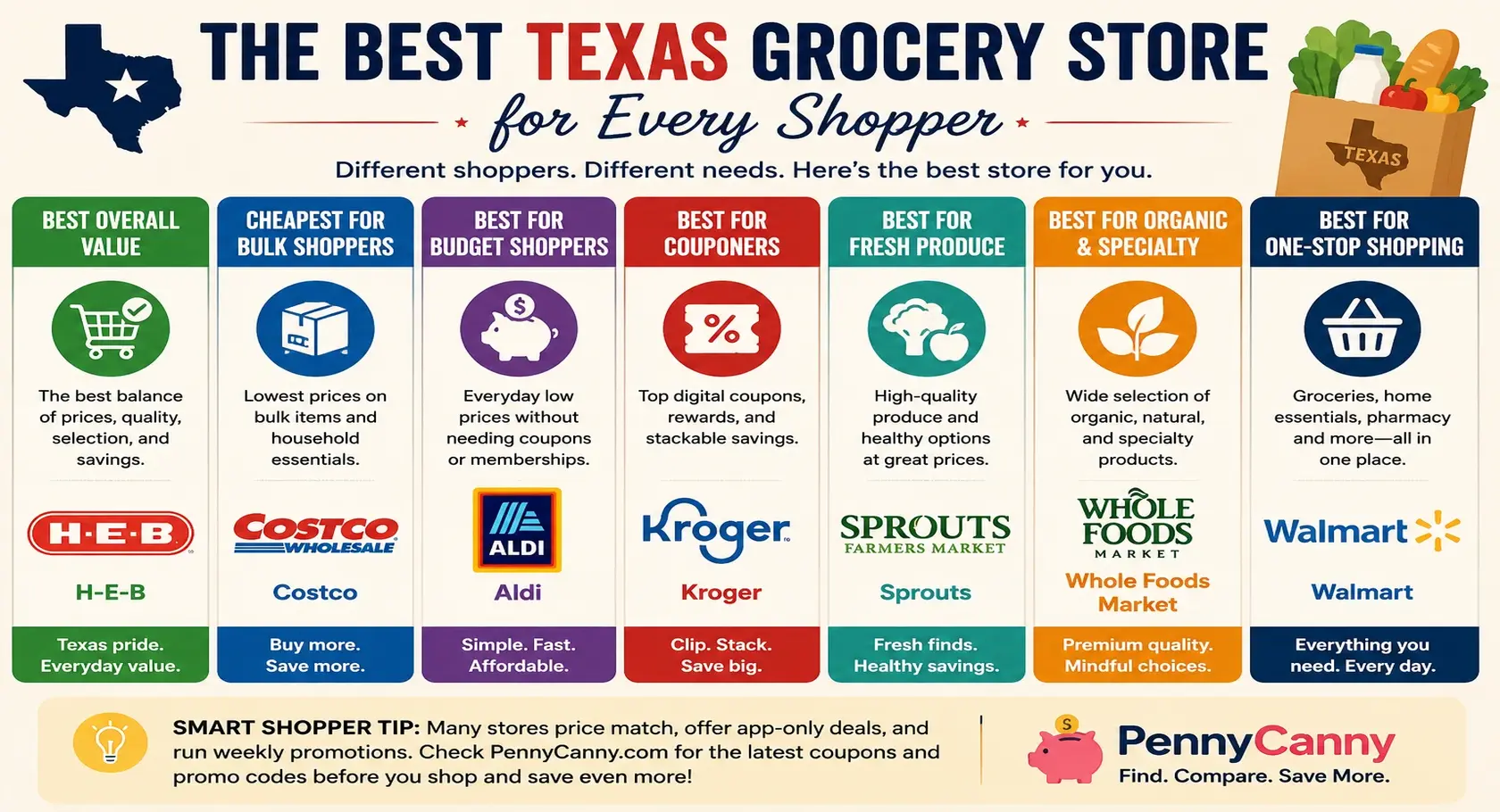
Not every grocery store is the best choice for every shopper. If you are short on time, this quick guide can help you choose the Texas grocery store that best matches your shopping style and budget.
| If you are a… | Best Texas Grocery Store | Why |
|---|---|---|
| College student | Aldi | Lowest everyday prices without requiring coupons or a membership. |
| Family of 5 | Costco | Bulk groceries and household essentials offer the best long-term value. |
| Coupon shopper | Kroger | Digital coupons, weekly promotions, and Fuel Points help maximize grocery savings. |
| Organic shopper | Sprouts Farmers Market | Fresh produce and natural foods at more affordable prices than many premium grocers. |
| One-stop shopper | Walmart | Groceries, pharmacy, household essentials, and convenient pickup services in one place. |
| Most Texas shoppers | H-E-B | The best overall balance of prices, quality, store brands, and customer experience. |
If you want to look into the details, here’s everything I found.
I ranked each store on four things:
At PennyCanny, we don’t rank grocery stores based only on advertised prices. We also evaluate the savings opportunities shoppers actually use, including digital coupons, loyalty rewards, store-brand value, weekly promotions, and cashback stacking.
For this guide, I combined independent pricing research with PennyCanny’s analysis of coupon programs and shopping strategies to identify which Texas grocery stores deliver the best overall value—not just the lowest shelf prices.
I also checked my findings against independent data so this isn’t just one shopper’s opinion. Consumer Reports ran a major supermarket price study in 2026, collecting shelf prices in six metro areas including Dallas and Fort Worth, with Walmart as the baseline. And Dunnhumby’s Retailer Preference Index surveyed more than 11,000 American shoppers across 81 grocery retailers. I’ll reference both throughout.
One more piece of context before the rankings. Texas is already a cheap state for groceries. A Food Label Maker study found that grocery costs in Texas run about 9.7% below the national average, the lowest in the country. That means the gap between a good store and a bad one here is pure savings you can actually capture.
| Rank | Store | Price Level | Coupons & Loyalty | Best For |
| 1 | H-E-B | Low | Strong (app coupons) | Best overall value |
| 2 | Costco | Lowest (bulk) | Member deals | Big families, stocking up |
| 3 | Joe V’s Smart Shop | Lowest (regular sizes) | Weekly ads | Tight budgets in Houston/DFW |
| 4 | Aldi | Very low | None (already low) | Small, fast, cheap trips |
| 5 | Walmart | Low | Walmart+ perks | One-stop shopping |
| 6 | Sam’s Club | Very low (bulk) | Member deals | Costco alternative |
| 7 | Kroger | Mid to high | Best in Texas | Coupon and deal shoppers |
| 8 | Sprouts | Mid | Weekly sales | Produce and health foods |
| 9 | Fiesta Mart | Mixed | Weekly ads | International ingredients |
| 10 | Trader Joe’s | Mid | None | Affordable specialty items |
| 11 | Tom Thumb / Randalls | High | Good (“for U” program) | Convenience, sale-only trips |
| 12 | Central Market | High | Limited | Quality splurges |
| 13 | Whole Foods | Highest | Prime discounts | Organic and specialty |
Rankings reflect overall value for a typical weekly shop, not price alone. Here’s the full breakdown.
H-E-B is the answer to “where do most Texans shop?” and the data backs the loyalty. Dunnhumby named HEB the number one grocery retailer in America in its 2026 index, the fifth time it has topped the ranking in nine years, citing its mix of savings, quality, experience, and assortment.
On price alone, H-E-B lands right at Walmart’s level. Consumer Reports found H-E-B baskets averaged 0.2% cheaper than Walmart in 2026. That sounds like a tie. It isn’t. You’re getting Walmart pricing with noticeably better produce, an in-house bakery, fresh tortillas, and store brands people genuinely brag about.
A local news test made the point even sharper. When KPRC 2 in Houston bought identical items at three stores, the H-E-B cart came to $60.61, Walmart hit $64.67, and Kroger reached $72.19.
Where H-E-B saves you money:
Looking for additional savings? Check the latest H-E-B online promo codes and coupons before shopping.
The catch: stores get crowded, and West Texas and El Paso still have limited coverage. With more than 345 Texas locations, though, most of the state is within reach.
Want the head-to-head numbers? See my full HEB vs Kroger comparison and HEB vs Walmart breakdown.
If we’re talking pure price per unit, Costco beats every grocery store on this list. Consumer Reports found Costco prices average 21.4% below Walmart, the biggest discount of any retailer in its 2026 study.
That’s a massive gap. On a $150 weekly shop, matching Walmart items at Costco prices saves roughly $30 a week, or about $1,500 a year.
The two catches:
Kirkland Signature, Costco’s store brand, is quietly one of the best private labels in the country. Rotisserie chicken, olive oil, coffee, and paper goods are standout buys.
Costco offers military discounts, teacher and student discounts, and other professional discounts, such as first responders and government employees. You may sometimes find specific online Costco coupon codes for same-day grocery delivery or targeted member-only promotions.
Verdict: the cheapest Texas grocery option for families of four or more with storage space. Singles and couples should look further down this list.
Here’s the store most Texans outside Houston haven’t heard of yet. Joe V’s Smart Shop is H-E-B’s discount format, launched in 2010, now expanding across Houston and Dallas-Fort Worth.
The pitch is simple: many of the same HEB products, stripped-down stores, lower prices. We are talking 3 pounds of bananas for a dollar, bolillos at 8 for a dollar, and meat bundle boxes starting around $20, Grocery Dive reports H-E-B keeps opening new Joe V’s locations precisely because price-conscious shoppers keep showing up.
Where Joe V’s saves you money:
The catch: only around 15 locations, all in the Houston and DFW areas. If you live near one, this might quietly be the cheapest full grocery store in Texas for regular-sized packages.
Aldi runs lean on purpose. Small stores, mostly store brands, a quarter deposit for your cart, bring your own bags. In exchange, Consumer Reports pegs Aldi at 8.3% cheaper than Walmart on average.
The store brand quality surprised me. Aldi’s dairy, snacks, and baking staples hold their own against name brands, and the weekly Aldi Finds aisle is a fun wildcard.
The catch: limited selection. You won’t find every brand or size, and produce quality varies by location. Most Aldi shoppers pair it with one other store.
Verdict: the best choice in Texas for a fast, cheap trip when you’re flexible on brands. Curious how it stacks up against the hometown favorite? Read Aldi vs HEB.
There’s a reason Consumer Reports uses Walmart as its pricing baseline: it’s the largest grocery retailer in the country, and its everyday prices set the bar. In Texas, Walmart is everywhere, including rural towns no other chain on this list serves.
Buying groceries, tires, and a birthday gift in one trip is incredibly convenient. And Walmart’s store brands, Great Value and bettergoods, keep improving.
As far as discounts, the brand offers Walmart promo codes online and also gives student memberships and employee discounts.
The catch: produce and meat quality trail H-E-B and even Aldi at many locations, and the shopping experience is nobody’s favorite. Several stores on this list now match or beat Walmart’s prices while offering a better cart of food.
Verdict: a solid default, especially where it’s the only option. If you have an HEB or Aldi nearby, compare before assuming Walmart wins. My full HEB vs Walmart comparison runs the numbers item by item.
Sam’s Club is Walmart’s warehouse club, and it plays the same game as Costco. Yes, I am talking about membership fees, bulk sizes, and low unit prices. The entry membership runs $50 a year, cheaper than Costco’s $65.
Member’s Mark, the house brand, is hit or miss compared to Kirkland, but the hits (rotisserie chicken, snacks, paper products) are real. Sam’s Club also tends to have shorter lines, and its Scan & Go app lets you skip checkout entirely.
Verdict: If you live closer to a Sam’s than a Costco, or you’re already deep in the Walmart ecosystem, the savings are comparable. Bulk-buying rules still apply: only cheap if you use it all.
Kroger is the most interesting store on this list, because the sticker prices and the real prices are two different stores.
At full price, Kroger is expensive. Consumer Reports found Kroger baskets ran 14.7% above Walmart in the Dallas-Fort Worth market. That KPRC 2 Houston test I mentioned earlier? Kroger’s cart cost $11.58 more than HEB’s for the same items.
But Kroger shoppers know the trick. Nobody pays full price at Kroger. The Kroger app loads hundreds of digital coupons, weekly sales cut deep, and fuel points knock up to a dollar per gallon off gas. Stack a sale price with a digital coupon, and Kroger frequently beats everyone on that specific item.
Where Kroger saves you money:
The catch: value at Kroger requires effort. Shop the app, plan around sales, and it rewards you. Walk in and grab what you need, and you’ll overpay.
Verdict: the best Texas grocery store for coupon shoppers, and the priciest mainstream option for everyone else. See exactly where each store wins in my HEB vs Kroger comparison.
Sprouts, with more than 60 Texas locations, built its reputation on produce. The stores are laid out like a farmers market, produce in the center, and the weekly produce sales are legitimately cheap. Think avocados, berries, and peppers at prices that beat conventional stores.
Vitamins, bulk bins, and natural and organic packaged goods round out the appeal. Full-price packaged items cost more than H-E-B or Walmart, so the play is simple: shop the sales.
Verdict: the best value in Texas for produce-heavy and health-focused shopping, as a supplement to a cheaper main store.
Fiesta Mart runs about 60 stores across Houston, Dallas, and Austin, focused on Hispanic and international foods. For fresh tortillas, dried chiles, tropical produce, and cuts of meat mainstream chains don’t carry, Fiesta is the place.
The pricing picture is mixed. Consumer Reports measured Fiesta baskets at 21.7% above Walmart in DFW on comparable items, yet its produce deals and weekly ad specials can be exceptional. Shop the perimeter and the weekly ad; skip the center aisles at full price.
Verdict: worth a regular stop for produce and international ingredients, not for the full weekly haul.
Trader Joe’s is beloved for a reason. Nearly everything carries the TJ’s label, quality is consistent, and the frozen aisle and snack selection are unmatched at their prices. Where else does a decent bottle of wine cost a few bucks?
The value math flips on staples. Consumer Reports found Trader Joe’s baskets averaged 33% above Walmart in the DFW area. Milk, eggs, and pantry basics simply cost more per ounce here, and package sizes run small.
Verdict: great as a treat stop for specialty items, a budget mistake as your main store. Note there are no coupons, ever. Prices are what they are.
Tom Thumb (DFW) and Randalls (Houston and Austin) are Albertsons-owned sister chains, and together with Albertsons stores they account for roughly 247 Texas locations. They are often the closest store in older neighborhoods, clean and well staffed.
Shelf prices, though, run consistently above HEB and Walmart. These stores follow a classic high-low model: high everyday prices, aggressive sales.
Tom Thumb offers coupons for new and existing users, and they also offer exclusive community grocery discounts. As for Randalls, they are one of the most coupon-friendly grocery stores in Texas.
That makes the “for U” loyalty program non-negotiable. It loads digital coupons, personalized deals, and gas rewards, and the weekly ad regularly features loss leaders worth a detour. Buy only sale items with loaded coupons and Tom Thumb can be a bargain. Shop it like a default store and it will cost you.
Verdict: a convenience play. Fine for sale items and quick trips, expensive as your everything store.
Central Market is H-E-B’s gourmet concept, and it’s the best food shopping experience in Texas, full stop. Hundreds of cheeses, an in-house bakery, chef-prepared foods, and produce variety no one else touches.
You pay for it. This is not a value store in the coupon sense, and it doesn’t pretend to be. The move is targeted shopping: the bulk spice section is genuinely cheap, the bakery beats standalone bakeries on price, and Hatch chile season is an event.
Verdict: budget it as an occasional trip for entertaining and specialty items, and it earns its place.
Someone has to be last. Consumer Reports found Whole Foods baskets ran 48% above Walmart in the Dallas-Fort Worth market, the largest premium of any store measured there. On a $150 weekly shop, that’s roughly $70 extra for a comparable cart.
Whole Foods offers online grocery delivery and pickup across Texas via Amazon and Instacart. Amazon Prime members get extra discounts and sale prices that soften the blow.
To be fair, Whole Foods has strengths: high quality standards, strong prepared foods, and the 365 store brand keeps improving.
Verdict: Shop it for specific organic and specialty items you can’t find elsewhere. As a primary Texas grocery store, it’s the most expensive choice on this list by a wide margin.
PennyCanny tracks grocery coupons, promo codes, and retailer promotions year-round. So this section reflects both published loyalty programs and the practical savings strategies shoppers can use every week.
Saving money at grocery stores in Texas works in two steps. Store choice sets your baseline. Coupons decide your final number.
| Grocery Store | Digital Coupons | Loyalty Program | Fuel Rewards | Coupon Stacking | PennyCanny Take |
|---|---|---|---|---|---|
| Kroger | ⭐⭐⭐⭐⭐ | ⭐⭐⭐⭐⭐ | ✅ Yes | ⭐⭐⭐⭐⭐ | Best overall for coupon shoppers. Stack digital coupons, weekly sales, and Fuel Points for the biggest savings. |
| H-E-B | ⭐⭐⭐⭐☆ | ⭐⭐⭐☆☆ | ❌ No | ⭐⭐⭐⭐☆ | Easy-to-use app coupons, Combo Loco deals, and yellow in-store coupons make savings effortless. |
| Tom Thumb / Randalls | ⭐⭐⭐⭐☆ | ⭐⭐⭐⭐☆ | ✅ Yes | ⭐⭐⭐⭐☆ | Excellent if you shop weekly ads and use the “for U” app. Avoid paying full shelf price. |
| Walmart | ⭐⭐☆☆☆ | ⭐⭐☆☆☆ (Walmart+) | ❌ No | ⭐⭐☆☆☆ | Few traditional coupons, but Walmart+ perks and occasional promo codes help online shoppers. |
| Costco | ⭐☆☆☆☆ | ⭐⭐⭐⭐☆ (Membership) | ❌ No | ⭐☆☆☆☆ | No coupons, but monthly Member Savings and bulk pricing deliver consistent value. |
| Sam’s Club | ⭐☆☆☆☆ | ⭐⭐⭐⭐☆ (Membership) | ❌ No | ⭐☆☆☆☆ | Instant Savings events replace traditional coupons. Best for bulk shoppers. |
| Aldi | ❌ None | ❌ None | ❌ No | ❌ None | Everyday low pricing means coupons aren’t part of the strategy. |
| Trader Joe’s | ❌ None | ❌ None | ❌ No | ❌ None | No coupons or loyalty program. Focuses on consistent pricing. |
| Sprouts | ⭐⭐⭐☆☆ | ⭐⭐⭐☆☆ | ❌ No | ⭐⭐⭐☆☆ | Weekly digital deals and produce promotions offer worthwhile savings. |
| Fiesta Mart | ⭐⭐⭐☆☆ | ⭐⭐☆☆☆ | ❌ No | ⭐⭐⭐☆☆ | Weekly ads provide the best opportunities, especially for produce and international foods. |
| Central Market | ⭐☆☆☆☆ | ❌ None | ❌ No | ⭐☆☆☆☆ | Limited promotions. Best approached as a premium shopping destination. |
| Whole Foods | ⭐⭐☆☆☆ | ⭐⭐⭐☆☆ (Prime) | ❌ No | ⭐⭐☆☆☆ | Prime member discounts are the primary way to save. |
Quick takeaway: If your goal is maximizing coupon savings, Kroger is the clear winner. If you prefer low-effort savings without planning every trip, H-E-B offers the best balance of everyday prices and digital coupons. Warehouse clubs like Costco and Sam’s Club rely on low prices instead of traditional couponing, while Aldi and Trader Joe’s intentionally avoid coupons altogether.
Here’s how the coupon game actually works at Texas grocery stores in 2026, ranked by how much effort pays off.
Kroger has the strongest coupon program in Texas. Load digital coupons in the app before you shop, stack them with weekly sales, and watch for mega events where buying 5 qualifying items drops each price further. Fuel points sweeten every trip. This is the only store where couponing can flip a store from “expensive” to “cheapest in town.”
H-E-B keeps it simple. Digital coupons live in the My H-E-B app and clip with one tap. The famous yellow in-store coupons attached to shelves stack on top of already low prices, and Combo Loco deals hand you free items with qualifying purchases. Low effort, steady payoff.
Tom Thumb and Randalls require the “for U” app. Without it, you’re paying some of the highest shelf prices in the state. With it, personalized deals and loaded digital coupons bring select items below H-E-B prices. Never shop these stores without checking the app first.
Aldi, Trader Joe’s, and Costco don’t do traditional coupons. Their model is everyday low pricing instead. Costco runs monthly member savings books, which are worth scanning, but there’s nothing to clip.
Cashback apps work everywhere. Ibotta and Fetch pay real money back on receipts from nearly every store on this list, and they stack on top of store coupons. Texas shoppers commonly pull an extra $10 to $30 a month this way with minimal effort.
One rule ties all of this together: a coupon only saves money on something you were already buying. Grocery prices nationwide have climbed almost 30% over the past five years, according to WalletHub, and stores know shoppers are hunting deals. Don’t let a good coupon talk you into a bad purchase.
After all the comparisons, here’s what I actually do, and what the numbers support.
Pick one low-price anchor store for your weekly basics: HEB if you have one, otherwise Aldi, Joe V’s, or Walmart. Then add one specialist: Costco for bulk if you’re feeding a family, Kroger if you enjoy working the coupon system, or Sprouts for produce.
Most Americans already shop at least two grocery stores each week, according to Consumer Reports. The difference is doing it on purpose. Matching each store to what it does best is worth $100 to $300 a month for a typical Texas family, and you don’t have to give anything up to get it.
WalletHub puts average Texas grocery spending at $119.50 for a standard basket of 26 common items, among the most affordable in the nation relative to income. Shop the right stores and you’ll beat that average comfortably.
Costco has the lowest prices in Texas, averaging 21.4% below Walmart per Consumer Reports 2026 data, but it requires a $65 membership and bulk buying. For regular package sizes without a membership, Aldi and Joe V’s Smart Shop are the cheapest, with H-E-B and Walmart close behind.
Yes, barely. Consumer Reports found HEB prices average 0.2% below Walmart’s. In a Houston test by KPRC 2, an identical basket cost $60.61 at H-E-B versus $64.67 at Walmart. The bigger difference is quality: H-E-B wins on produce, meat, and store brands at essentially the same price.
At regular prices, yes. Kroger’s shelf prices ran 14.7% above Walmart in the DFW market per Consumer Reports, while H-E-B matched Walmart. But Kroger’s digital coupons, weekly sales, and fuel points can beat H-E-B on specific items for shoppers who plan around deals.
H-E-B combines low prices with high quality, a rare mix. Dunnhumby’s 2026 Retailer Preference Index, based on surveys of over 11,000 shoppers, ranked H-E-B the number one grocery retailer in America for the fifth time in nine years. Its Texas-made store brands, fresh tortillas, and disaster relief efforts add genuine local loyalty.
H-E-B, Central Market, Joe V’s Smart Shop, and Mi Tienda are all Texas-only banners owned by H-E-B. Brookshire’s (East Texas) and United Supermarkets and Market Street (West Texas and the Panhandle) are also Texas-based regional chains.
Yes. Texas has the lowest average grocery prices in the country, about 9.7% below the national average according to a Food Label Maker study. Low costs of living, strong competition among chains like H-E-B, Walmart, Aldi, and Kroger, and local food production all help keep prices down.
Kroger. Its app combines digital coupons, personalized offers, mega sale events, and fuel points, the deepest savings stack of any Texas grocery chain. H-E-B’s app coupons are easier to use, and Tom Thumb and Randalls offer strong deals through the “for U” program, but Kroger rewards dedicated couponers the most.
 Author:
Madison Clarke