


Elicit is widely used for AI-assisted literature summaries and rapid evidence extraction. It helps researchers surface relevant papers quickly and distill key findings with minimal effort.
However, advanced academic research rarely stops at summaries.
PhD candidates, systematic reviewers, and faculty researchers often require advanced tools. Tools that support structured discovery, citation credibility, deep PDF comprehension, evidence validation, and long-term research management.
These needs extend beyond Elicit’s core strengths.
As research workflows grow more complex, scholars prefer specialized AI tools. Software designed for systematic reviews, multilingual discovery, citation intelligence, visual literature mapping, and integrated writing environments.
This guide evaluates the most capable Elicit alternatives based on how well they support real academic workflows.
TL;DR: The Most Capable Elicit Alternatives
Here’s how different Elicit alternatives for research can help PHD students with tasks.
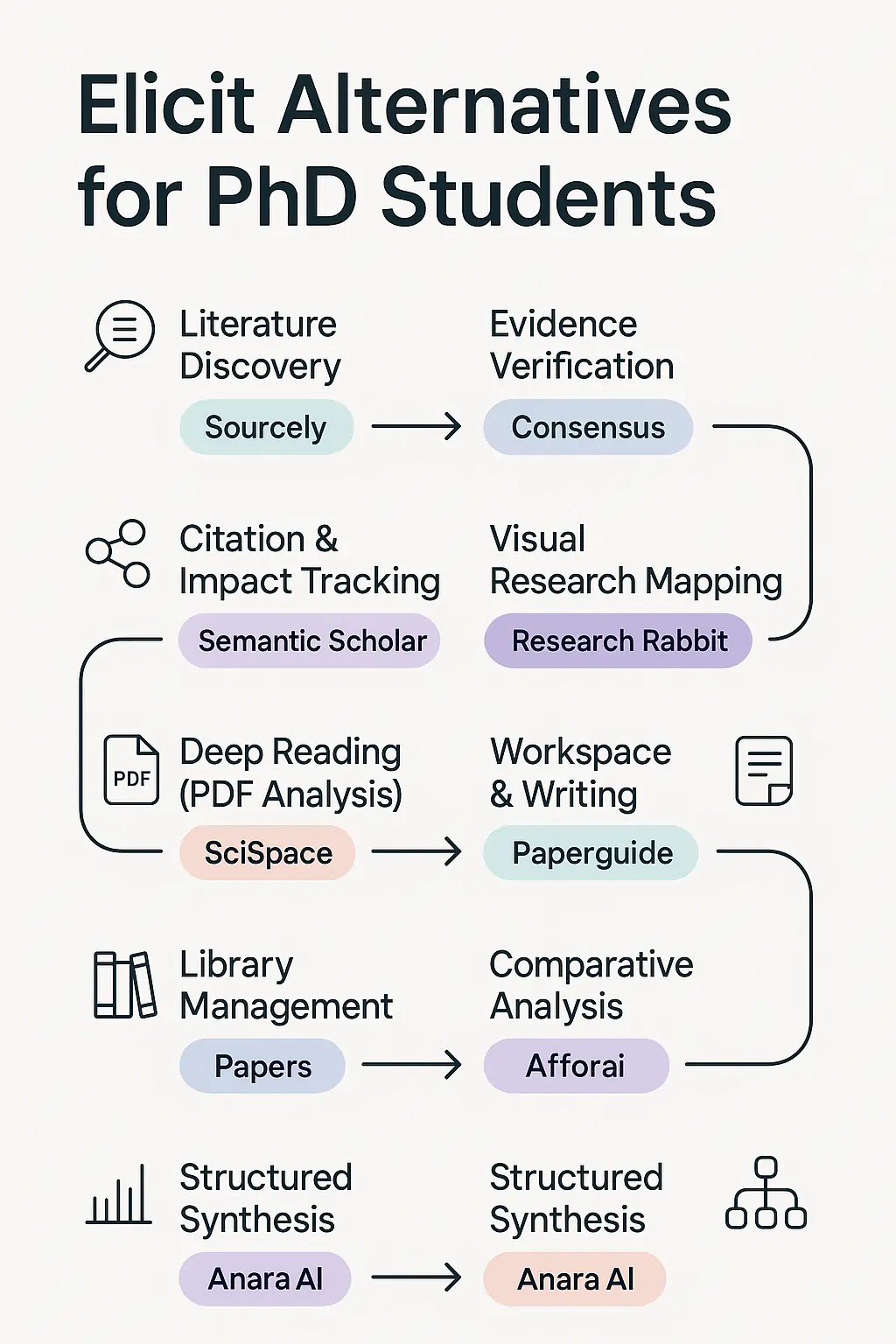
If you have time, we have discussed more Elicit alternatives in detail.
Elicit is a popular tool for its rapid paper summaries.
This research tool is excellent for automated literature searches and extracting key findings. It is invaluable for rapid literature reviews or brainstorming research questions.
However, topic research at advanced levels often requires broader capabilities. For that, researchers need better tools to organize claims, trace influence, compare evidence, or build research libraries.
And Elicit has some limitations:
For these reasons, many researchers (especially PhD students) combine Elicit with other “all-in-one” research tools.
BTW, you can find discount coupons for paid software on PennyCanny.
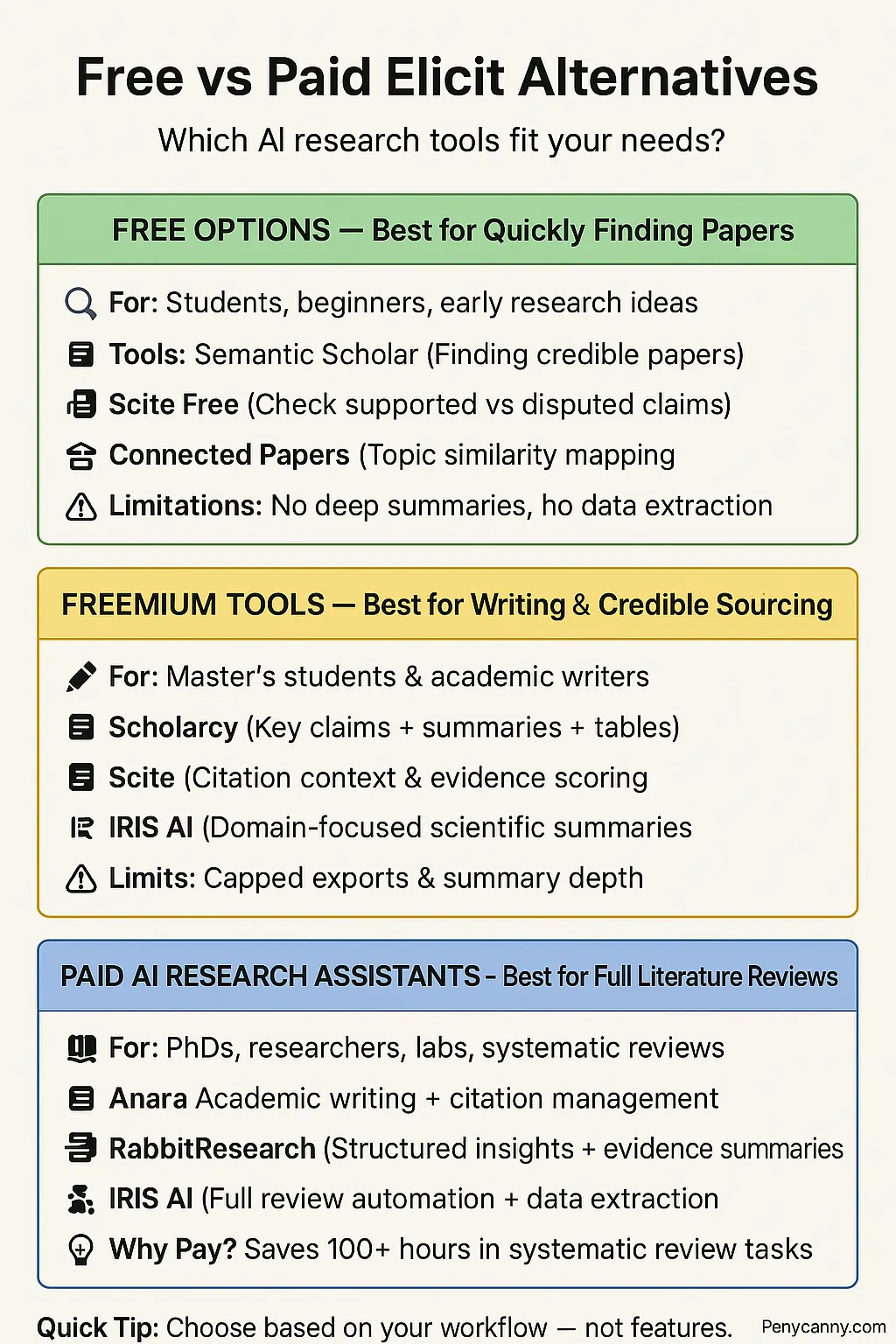
PhD candidates, supervisors, systematic reviewers, and early-stage researchers need credible tools. They sought software they can rely on for deeper academic discovery beyond basic summarization.
Here’s a brief intro to these Elicit alternatives for research purposes.
| Tool | Best For | Strength |
|---|---|---|
| Sourcely | Budget-friendly multilingual research | AI search + citations + downloads |
| Semantic Scholar | Citation credibility | Highly trusted, 200M+ papers |
| Research Rabbit | Visualizing literature gaps | Visual citation & co-author maps |
| Iris AI | Systematic literature reviews | Data extraction + research maps |
| Perplexity AI | Real-time exploratory research | Conversational results + PDFs |
Ideal For: Students who need accurate sources in multiple languages, fast citation help, and affordable AI assistance.
Sourcely uses multilingual, AI-driven search to discover reliable academic papers. It automatically generates citations in APA, MLA, and Chicago formats. With Sourcely, you also get PDF download access and paper summaries.
| Feature | Description | Benefit for Researchers |
|---|---|---|
| Multilingual Search | Results in 100+ languages | Great for cross-cultural research |
| Citation Generator | APA/MLA/Chicago support | Saves formatting time |
| PDF Downloads | Full paper access | Eliminates paywall frustration |
| Source Summarization | Condenses academic content | Speeds literature review |
| Plan | Price | Best For |
|---|---|---|
| Free | $0 (300-char limit) | Quick searches |
| PRO 2000 | $9 | Short research projects |
| PRO Monthly | $17/month | Ongoing reviews & theses |
| PRO Yearly | $167/year | Long-term PhD research |
Ideal For: Researchers requiring credible evidence, author impact scores, citation tracking, and research influence metrics.
Semantic Scholar is backed by the Allen Institute for AI. It indexes 200M+ peer-reviewed papers. It emphasizes impactful research discovery, not just broad search.
| Feature | How It Helps |
|---|---|
| Citation-Based Ranking | Prioritizes influential research |
| Author Profiles | Track experts in your field |
| Citation Export | Easy APA/MLA/Chicago downloads |
| AI Summaries | Quick paper digestion |
Use Semantic Scholar If You Need:
| Access Level | Cost |
|---|---|
| Full Access | 100% Free |
Ideal For: Researchers needing scientifically accurate results with verified citations, especially in medical, psychology, and applied sciences.
Consensus only extracts findings from peer-reviewed studies, eliminating the risk of non-scientific sources.
| Feature | Description |
|---|---|
| Evidence Synthesis | Answers based on scientific consensus |
| Verified Peer-Reviewed Sources | No blogs or non-peer-reviewed sources |
| Claim Extraction | Helps evaluate research claims |
| Question-Based Search | Ask research questions directly |
Use Consensus If You Need:
| Plan | Cost |
|---|---|
| Free Plan | Limited queries |
| Premium | Upcoming pricing tiers |
Ideal For: Students handling complex papers, equations, technical language, and dense theoretical PDFs.
SciSpace (formerly Typeset) reads and explains research PDFs like a professor. It clarifies methods, statistics, assumptions, and key claims to users.
SciSpace offers:
| Feature | Benefit |
|---|---|
| Section-by-section breakdown | Understand methods and results faster |
| Ask Questions About PDFs | Clarify theory, stats, or models |
| Reference Finder | Tracks cited sources instantly |
| Smart Summaries | Extract hypotheses, metrics, and data |
Use SciSpace If You Need:
SciSpace is suitable for fields where methodology, equations, or domain terminology require interpretation beyond summarization. It is a “reading assistant,” not just a literature searcher.
| Plan | Price | Best For |
|---|---|---|
| Free | Limited queries | Beginners |
| Pro | $8–$12/month | PhD students & labs |
| Institutional | Custom | Universities |
Ideal For: Fast exploratory research, current trends, and preliminary literature scanning with citations.
Perplexity’s Academic Mode crawls scholarly databases and real-time sources. Thus, it provides citation-backed answers.
| Feature | Benefit |
|---|---|
| Conversational Questioning | Ideal for early research stages |
| Real-Time Academic Search | Updated studies + trends |
| File Analysis | Summarize + extract research |
| Citations Included | Direct links + references |
Use Perplexity If You Need:
| Plan | Price |
|---|---|
| Free | Unlimited search + 5 Pro queries/day |
| Pro | $20/month |
Important Note: For high-stakes claims (clinical, policy, meta-analysis), prioritize “peer-reviewed evidence.” Its betetr to document your search strategy for reproducibility.
PhD students often need a full research workflow. Hence, they search for tools that can discover, annotate, synthesize, manage references, and even draft sections of papers or dissertations.
The tools below are designed to replace juggling multiple platforms. These AI software offer “all-in-one” workspaces that complement or surpass Elicit in different stages of research.
Best For: PhD students and researchers who want a single platform for discovery, reading, analysis, and drafting.
Paperguide combines:
Unlike Elicit, Paperguide allows researchers to store and organize research and generate structured drafts. This Elicit alternative links every claim to its source.
| Feature | Description | Value for Researchers |
|---|---|---|
| AI Research Assistant | Summarizes papers, extracts key points | Saves hours of manual reading |
| Integrated Writing | Draft sections with citation-linked content | Speeds up literature reviews |
| Reference Management | Built-in citation library | Replaces external tools like Zotero |
| Workspace Library | Organize projects, PDFs, notes | Centralized, long-term research management |
Where it beats Elicit:
Paperguide is valuable for researchers writing dissertations or drafting literature review chapters. It significantly reduces manual effort. However, AI-generated content always requires human interpretation and editing for academic rigor.
| Plan | Price | Key Features |
|---|---|---|
| Free | $0 | Limited AI summaries, basic library |
| Pro | $12-$24/month | Full AI writing, citation exports, unlimited storage |
Best For: Researchers who need professional library management and citation tools alongside discovery from large databases (Dimensions).
Papers stores all PDFs, notes, and annotations in a searchable library and connects to the world’s largest linked research database.
Papers by ReadCube combines:
While Elicit provides summaries, Papers is optimized for long-term management of research material.
| Feature | Description | Value for Researchers |
|---|---|---|
| PDF Library | Centralized storage for all documents | Easy retrieval & long-term organization |
| Dimensions Search | Access millions of linked papers | Broader discovery than Elicit alone |
| Annotation & Notes | Highlight, comment, organize | Keeps research structured |
| Reference Management | Export citations in multiple formats | Ensures academic integrity |
Where it beats Elicit:
Papers is not a “summarizer tool.” It is a serious infrastructure choice for researchers planning multi-year PhD work, lab documentation, or publication pipelines.
| Plan | Price | Key Features |
|---|---|---|
| Student | $65/year | Full library, database search, citation tools |
| Professional | $120/year | Advanced annotation, search, and collaboration |
Best For: Researchers conducting comparative literature reviews or systematic analysis across multiple papers.
Logically (formerly Afforai) includes three research search/analysis modes:
This Elicit alternative allows simultaneous analysis of multiple documents. Thanks to its multiple modes, researchers get more coverage than Elicit for comparative workflows.
| Feature | Description | Value for Researchers |
|---|---|---|
| Multi-Paper Analysis | Compare multiple PDFs at once | Efficient for systematic reviews |
| AI Extraction | Summarizes key points across documents | Reduces manual note-taking |
| Flexible Search Modes | Google, Semantic Scholar, or custom documents | Broader search capabilities (multi-platforms) |
| Annotation Support | Broader coverage than a single-platform search | Organizes thematic findings |
Where it beats Elicit:
Logically app is best when you need to compare papers side-by-side. The software is good during early-stage literature reviews and comes with Logically discount codes.
| Plan | Price | Key Features |
|---|---|---|
| Free | $0 | Limited document queries |
| Standard | $3.99/month | Full multi-paper analysis, extraction |
| Pro | $7.99/month | Unlimited analysis and search modes |
For a PhD literature pipeline, I recommend mixing tools, not replacing everything:
Important Note: Validate AI outputs against original papers. Use the tool’s “show source/jump to the paper” function and quote the section you verify. Elicit, and the tools above give citations or source links, so always cross-check.
Not every research task requires a full, all-in-one workspace. Some tools excel at very specific stages of the academic workflow. You can use such software for mapping literature, validating claims, or automating systematic discovery.
The following Elicit alternatives deserve attention for those targeted use cases.
Best For: Identifying research gaps, tracking citation networks, and exploring adjacent literature visually.
Research Rabbit focuses on how papers relate to each other.
Instead of linear search results, it generates visual maps based on citations, co-authorships, and thematic similarity.
This makes it particularly effective for:
Where it fits best
Research Rabbit does not replace Elicit’s extraction capabilities. Instead, it complements them by revealing structure and influence across a research domain.
Best For: Researchers conducting structured or systematic reviews at scale.
Iris AI is designed around the logic of systematic research. It analyzes papers semantically to identify themes, relationships, and conceptual overlaps. It does not solely rely on keywords.
Key Iris AI strengths include:
Where it fits best
Compared to Elicit, Iris AI is less about quick summaries and more about structuring large bodies of literature.
Best For: Verifying claims and understanding how studies are cited in context.
Scite does not just show citation counts. It classifies citations as:
This allows researchers to evaluate how a paper is being used, not just how often it is cited.
Where it fits best
Scite is especially valuable in medical, policy, and social science research. These are research fields where citation context matters as much as citation volume.
Best For: Rapid synthesis of large document collections and internal research corpora.
Anara AI (formerly unriddle AI) focuses on extracting structured insights from multiple documents simultaneously. It is often used in applied research, policy analysis, and corporate or institutional research settings.
Anara AI’s key capabilities include:
Where it fits best
Anara beats Elicit when research requires full-cycle work. It is good for extraction, synthesis, annotation, and writing chapters. Students can use Anara AI promo codes to get discounts.
Elicit is an excellent “idea scout,” but not a research workstation. But this does not mean that all Elicit alternatives for research are perfect. Use these tools in combination to cover all stages of PhD research. Choosing the right tool at each stage maximizes efficiency and ensures scholarly rigor.
 Author:
Ahmad


Uncategorized
How to Save Money on Travel When You are on a Budget

Grocery
I Compared 13 Texas Grocery Stores, and Here’s Where You Get the Most for Your Money
Extreme Couponing
Stores that Price Match (21 Retailers that Offer Lower Prices)

Uncategorized
25 Gift Ideas for Beer Lovers in Your Life

Fashion
How to Save Money on Clothes

Uncategorized
Updated List of Moving Companies With Military Discounts

Uncategorized
Stores With Military Discounts for Veterans & Active-Duty Military
Explore More →